
The No-Nonsense Guide to Commercial Cabling Companies
What Is Low Voltage Cabling? (And Why Your Business Depends on It)
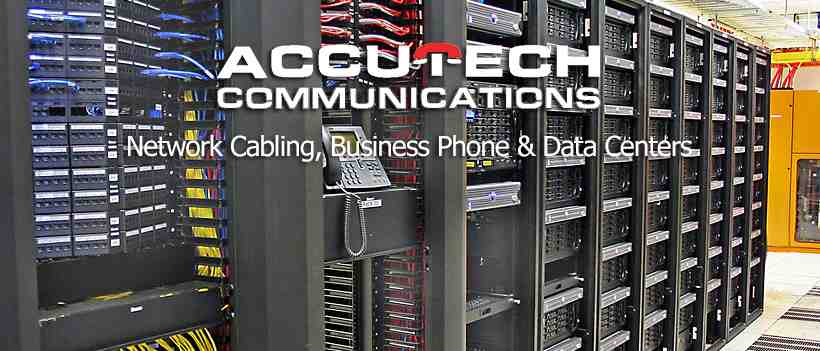
Low voltage cabling is the structured network of cables that carries data, voice, video, and control signals through your building — operating at 50 volts or less.
Here’s a quick breakdown:
| Feature | Low Voltage Cabling |
|---|---|
| Voltage range | 50V or less (commonly 12V, 24V, or 48V) |
| Purpose | Transmits signals, not power |
| Common systems | Ethernet, VoIP, security cameras, access control, AV, Wi-Fi |
| Who installs it | Certified low voltage contractors |
| Risk level | Lower than standard electrical wiring |
Think of it as the nervous system of your building. Every device that communicates — your IP phones, security cameras, wireless access points, and conference room displays — depends on this infrastructure to function.
Yet it’s one of the most overlooked parts of a commercial build-out. Many businesses only think about it after the walls are closed — which is far more expensive and disruptive to fix.
The wiring running behind your walls and above your ceilings is doing far more than you might realize. And when it’s done wrong, the entire operation feels it. Slow networks, dropped calls, failed security feeds — these aren’t IT problems. They’re cabling problems.
I’m Corin Dolan, owner of AccuTech Communications, and I’ve spent over 30 years designing and installing low voltage cabling systems for commercial clients across Massachusetts, New Hampshire, and Rhode Island. In this guide, I’ll walk you through everything you need to make smart, informed decisions about your building’s cabling infrastructure.
Simple Low voltage cabling glossary:
Understanding Low Voltage vs. High Voltage Wiring
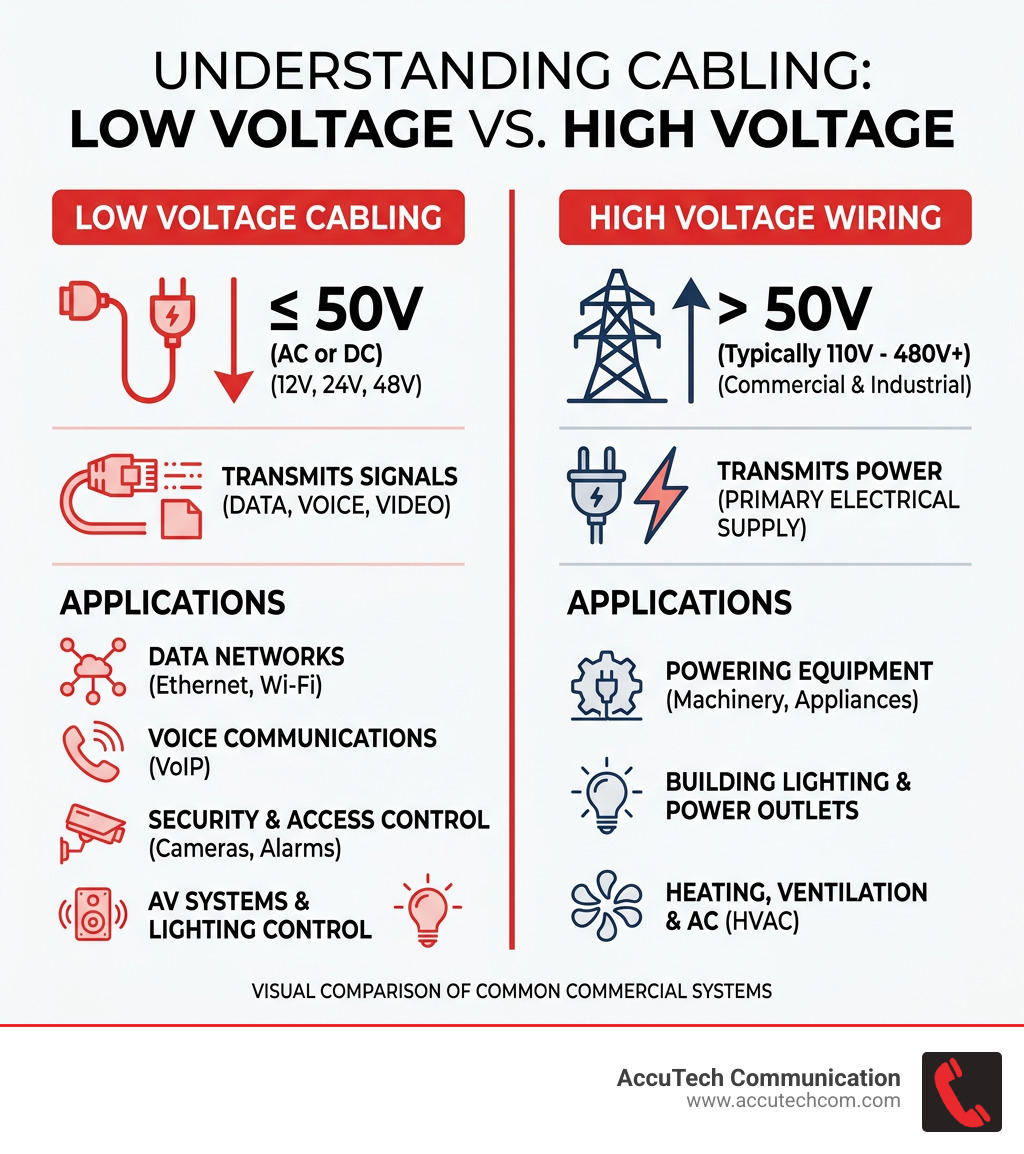
In commercial construction and facility management, the distinction between high-voltage and low-voltage systems is critical. High-voltage wiring (often called “line voltage”) typically operates between 120V and 240V in most North American commercial buildings. Its primary job is to deliver raw power to outlets, lighting fixtures, and heavy machinery. Because of the high energy levels, it poses a significant electrocution and fire risk, requiring installation by licensed electricians and strict adherence to specific sections of the National Electrical Code (NEC).
Low voltage cabling, on the other hand, operates under a 50V threshold. While it can carry small amounts of power—such as through Power over Ethernet (PoE)—its primary function is the transmission of data and control signals. This lower voltage makes the cables safer to handle and allows for greater flexibility in how they are routed through a building.
However, “safer” does not mean “simpler.” High-voltage wiring is robust; a slight nick in the insulation might not stop a lightbulb from shining. But in low voltage cabling, even a minor kink or electromagnetic interference can corrupt data packets, leading to slow internet speeds or dropped VoIP calls.
| Feature | High Voltage (Line Voltage) | Low Voltage (Signal/Data) |
|---|---|---|
| Typical Voltage | 120V, 240V, 480V | 12V, 24V, 48V (Max 50V) |
| Primary Goal | Power distribution | Communication & Signal |
| Safety | High risk (Electrocution/Fire) | Low risk (Safe to touch) |
| Cable Type | Thick, insulated (Romex, THHN) | Twisted pair, Fiber, Coax |
| Installation | Electrical Contractor | Low Voltage Specialist |
For more details on how these systems integrate into your facility, you can explore low-voltage data cabling to see how we design these backbones for Massachusetts and Rhode Island businesses.
Essential Types of Commercial Network Cables
Choosing the right cable is the difference between a network that lasts ten years and one that needs an upgrade in twenty-four months. In commercial settings, we primarily deal with three categories: twisted-pair copper, fiber optics, and coaxial.

The Role of Cat6A in Low Voltage Cabling
If you are building a new office in Boston or Worcester today, Category 6A (Cat6A) is the industry standard for a reason. While older Cat6 cables can support 10Gbps speeds, they are limited to shorter distances—often failing beyond 130 to 165 feet in high-density environments.
Cat6A, however, supports 10Gbps speeds up to the full 328-foot (100-meter) limit of standard Ethernet. It also features superior shielding and thermal efficiency, which is vital for Power over Ethernet. As businesses adopt high-wattage PoE devices like smart LED lighting and advanced pan-tilt-zoom cameras, the ability of Cat6A to dissipate heat becomes a safety and performance necessity.
Fiber Optics for High-Bandwidth Applications
For long-distance runs (such as connecting two ends of a large warehouse in New Hampshire) or for the “backbone” that connects server rooms, fiber optics are unbeatable. Unlike copper, fiber uses light signals to transmit data. This means it is entirely immune to electromagnetic interference (EMI) from fluorescent lights or heavy machinery. Fiber can reach terabit speeds and is essential for future-proofing any business that anticipates heavy data usage. You can learn more about our fiber optic installation services for commercial high-speed needs.
Coaxial RG6
While less common for data networking, coaxial cable remains a staple for satellite TV, certain security camera systems, and cable internet entry points. For commercial use, we always recommend solid copper RG6 over copper-clad steel to ensure the best signal integrity for 4K video feeds.
Key Business Applications and Systems
What exactly runs on low voltage cabling? In a modern office, almost everything except the coffee machine and the HVAC motors.
- VoIP Phone Systems: Modern business phones don’t use traditional phone lines; they run on Ethernet. A reliable cable run ensures crystal-clear audio and zero dropped connections.
- Security and Surveillance: IP cameras and NVR systems require high-bandwidth cabling to stream high-definition footage 24/7.
- Access Control: Keycard readers, mag-locks, and biometric scanners are all part of the low-voltage ecosystem, ensuring your building stays secure.
- Commercial Wi-Fi: Wireless access points (WAPs) are only as good as the wires feeding them. We often install multiple Cat6A drops to each WAP to ensure they have the bandwidth and power they need.
- AV and Conferencing: HDMI extenders, ceiling-mounted speakers, and digital signage all rely on structured cabling to deliver content without lag.
A well-designed structured cabling service integrates these disparate systems into a single, manageable infrastructure.
Best Practices for Professional Low Voltage Cabling Installation
The “mess of wires” found in many older server rooms isn’t just an eyesore—it’s a liability. Professional low voltage cabling follows strict standards set by BICSI (Building Industry Consulting Service International) and the NEC.
Proper Cable Management
Cables should never be left draped over ceiling tiles or tied to plumbing pipes. We use J-hooks, cable trays, and D-rings to provide support every few feet. This prevents the weight of the cable from stretching the copper (exceeding pull tension limits), which can physically degrade the data-carrying capacity of the wire.
Avoiding Interference in Low Voltage Cabling
One of the most common mistakes made by non-specialists is running data cables too close to high-power electrical lines. This creates “crosstalk” or electromagnetic interference that throttles network speeds. Best practices include:
- Maintaining at least 12 inches of separation from high-voltage lines.
- Crossing electrical conduits at a 90-degree angle if they must intersect.
- Using shielded cabling (STP) in environments with high interference.
For a deeper dive into how we handle these technical hurdles, see our guide on LV cable installation.
The Business Case: Costs and Future-Proofing
We often tell our clients in Massachusetts and New Hampshire that the most expensive cable is the one that wasn’t installed correctly the first time.
Research shows that having a single point of contact for your electrical and low-voltage needs can save a general contractor up to 20% on the total electrical installation cost. Furthermore, planning your cabling during the renovation or “studs-out” phase is significantly cheaper than trying to “fish” wires through finished drywall later.
Industry Average Costs
Based on publicly available industry data, a professional commercial cabling project can range significantly depending on the scale:
- Small Office (5-10 drops): $3,000 – $7,500
- Medium Enterprise (50+ drops + Fiber backbone): $15,000 – $45,000+
- Large Data Centers/Warehouses: $100,000+
Note: These ranges are based on general online data and industry averages to provide a sense of scale. They are not the specific rates of AccuTech Communications. Every project is unique, and factors like ceiling height, building material (brick vs. drywall), and cable category will influence the final estimate.
Investing in Category 6A cabling now is a smart move for future-proofing. As 10Gbps internet becomes the standard for businesses in metro-West Boston and beyond, having the right wires in the walls ensures you won’t have to tear them open again in five years.
Frequently Asked Questions about Commercial Cabling
What is the standard voltage for low voltage systems?
Most commercial low voltage systems operate at 12V, 24V, or 48V. Power over Ethernet (PoE) typically delivers around 48V to 57V to devices like phones and cameras, staying safely within the “low voltage” classification.
Do I need a license for low voltage installation in MA, NH, or RI?
Yes. Licensing requirements vary by state, but in Massachusetts, Rhode Island, and New Hampshire, specific electrical or low-voltage licenses are required for commercial installations. Using an unlicensed installer can lead to failed inspections, voided insurance policies, and potential fire hazards.
How often should a business upgrade its cabling?
A well-installed Cat6A or Fiber system should last 15 to 20 years. However, if your business is experiencing frequent network drops, slow speeds despite a high-speed ISP plan, or if you are still running on Cat5e, it is likely time for an upgrade to support modern IoT and PoE demands.
Conclusion
Your building’s technology is only as reliable as the wires that connect it. At AccuTech Communications, we’ve spent three decades proving that quality low voltage cabling is the foundation of a successful business. Whether you are outfitting a new medical facility in Brockton, a corporate office in Portsmouth, or a data center in Providence, our team brings the certification and experience needed to do the job right.
We pride ourselves on offering competitive pricing without cutting corners on the quality of our materials or our craftsmanship. Don’t let your business be throttled by poor infrastructure.
Ready to build a better network? Request an estimate for commercial cabling from AccuTech Communications today and let’s get your business connected.