
Why Finding the Right Ethernet Cable Installation Services Matters for Your Business
Ethernet cable installation services are the foundation of any high-performing commercial network — and choosing the right provider can mean the difference between seamless operations and costly downtime.
If you need a quick answer on what to look for, here it is:
What to look for in professional Ethernet cable installation services:
- Certified technicians with TIA/EIA compliance experience
- Commercial-grade cable (Cat6a or fiber for most business environments)
- Full-service process — site survey, installation, testing, and documentation
- Proven experience in your building type (retrofit, new construction, or data center)
- Post-installation certification with documented test results
Most businesses don’t think about their network cabling until something goes wrong. A dropped VoIP call during a client meeting. A server that keeps losing connectivity. A Wi-Fi dead zone that no access point seems to fix.
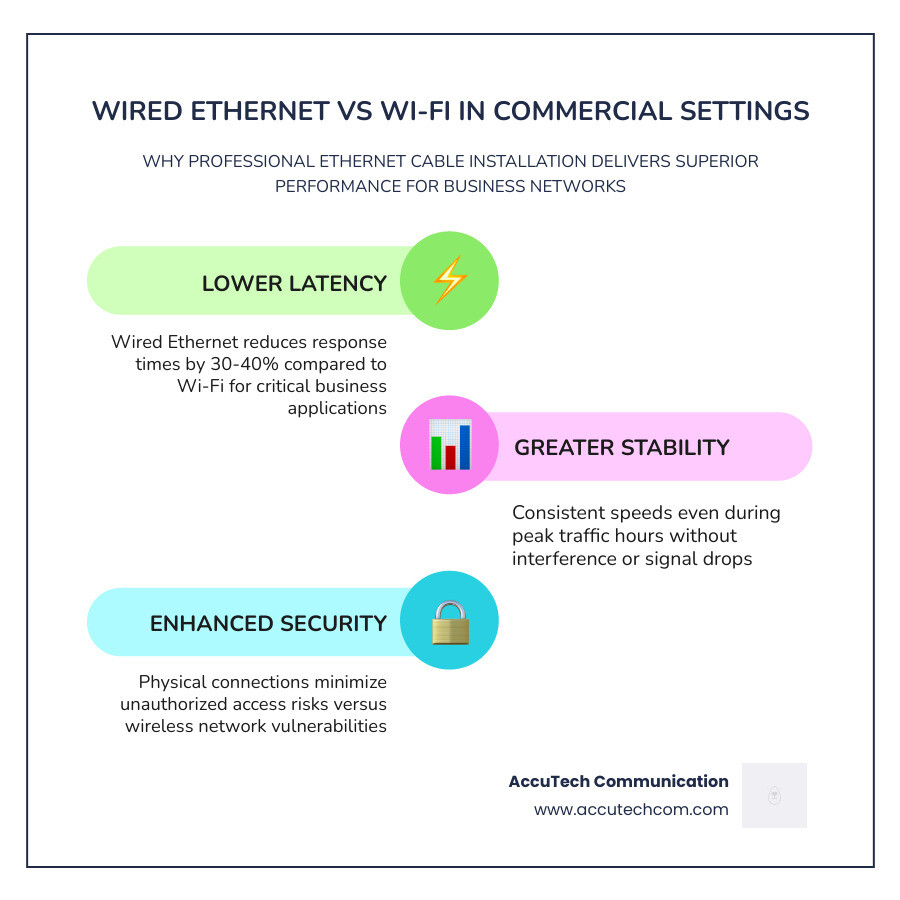
The reality is that wireless networks were never designed to carry the load of a modern commercial operation. A hard-wired Ethernet connection delivers up to 30-40% faster speeds than Wi-Fi — and far greater consistency under heavy traffic.
But the quality of a wired network is only as good as the installation behind it. Poorly routed cables, skipped testing, and wrong cable categories are among the most common reasons businesses end up paying twice — once for the original install, and again to fix it.
I’m Corin Dolan, owner of AccuTech Communications, and I’ve been delivering Ethernet cable installation services for commercial clients across Massachusetts, New Hampshire, and Rhode Island since 1993. In that time, I’ve seen what separates a network that holds up for decades from one that creates ongoing headaches — and this guide covers everything you need to know to get it right.
Key terms for Ethernet cable installation services:
Why Your Business Needs Professional Ethernet Cable Installation Services
In the business landscape of May 2026, a “good enough” connection isn’t good enough anymore. Whether you are running a medical facility in Boston, a warehouse in Manchester, or a tech startup in Providence, your physical cabling is the nervous system of your company.
When we talk about Ethernet cable installation services, we aren’t just talking about plugging in wires. We are talking about building a reliable infrastructure that supports your entire operation. A hard-wired connection provides significantly higher uptime than Wi-Fi-only solutions. While Wi-Fi is great for mobility, it is prone to interference from office equipment, building materials, and other wireless signals.
By investing in Professional Ethernet Cable Installation, you gain:
- Reduced Latency: Essential for VoIP stability and video conferencing without the “jitter.”
- Enhanced Security: Wired networks are much harder to intercept than wireless signals.
- Interference Mitigation: High-quality Network Cable Installation uses twisted-pair technology and shielding to block electromagnetic interference (EMI).
- Scalability: A properly designed system allows you to add more users and devices without redesigning the entire network.
Key Factors in Selecting Ethernet Cable Installation Services
Not all installers are created equal. In New England, building codes can be complex. When selecting a contractor, you need to ensure they are well-versed in TIA/EIA standards. These are the “rules of the road” for telecommunications cabling.
In Massachusetts and Rhode Island, specific low-voltage licensing may be required, and in New Hampshire, adherence to strict building and fire codes is non-negotiable. We always recommend choosing a team with deep commercial experience who understands the nuances of “plenum-rated” spaces—the areas above drop ceilings used for air circulation—which require special fire-resistant cabling.
Maximizing ROI with Expert Ethernet Cable Installation Services
The return on investment for high-quality cabling is found in the “avoided costs.” Recent industry data shows that IT downtime can cost businesses an average of $5,600 per minute. In high-stakes environments, that number has been known to climb as high as $14,000 per minute in 2024 and 2025.
By choosing Commercial Data Cabling that includes certified testing, you are buying insurance against these outages. A professional installation should come with long-term durability and, in many cases, manufacturer warranties that can span up to 25 years. This ensures your backbone remains strong as your business grows.
Comparing Commercial Cable Types: Cat6, Cat6a, and Fiber
Choosing the right cable is like choosing the right plumbing for a skyscraper; if you undersize the pipes, the whole system suffers. Here is how the most common commercial options stack up in 2026:
| Cable Type | Max Data Rate | Max Distance for Top Speed | Frequency | Best Use Case |
|---|---|---|---|---|
| Cat6 | 1 Gbps (up to 10 Gbps) | 37-55 Meters (for 10G) | 250 MHz | General office workstations |
| Cat6a | 10 Gbps | 100 Meters | 500 MHz | High-density offices, PoE++ |
| Fiber Optic | 100+ Gbps | 10+ Kilometers | N/A | Server backbones, multi-floor |
Using Cat 6 Cable Installation is often the baseline for modern businesses. However, Cat6a has quickly become the preferred standard for new commercial builds. Why? It handles 10-gigabit speeds over the full 100-meter distance and offers superior performance for Power over Ethernet (PoE) devices like security cameras and high-end Wi-Fi 7 access points.
When we provide Network Cabling Services, we also look at whether you need Shielded Twisted Pair (STP) to block heavy interference or Unshielded Twisted Pair (UTP) for standard environments.
Performance Standards for 2026
In 2026, 10-Gigabit Ethernet is no longer a luxury—it’s the expectation. With the rise of smart building integration and AI-driven data processing, your cables need to handle massive throughput. Furthermore, PoE++ compatibility is vital for powering everything from smart LED lighting to advanced HVAC controllers directly through the data line.
Fiber Optic Integration for Backbones
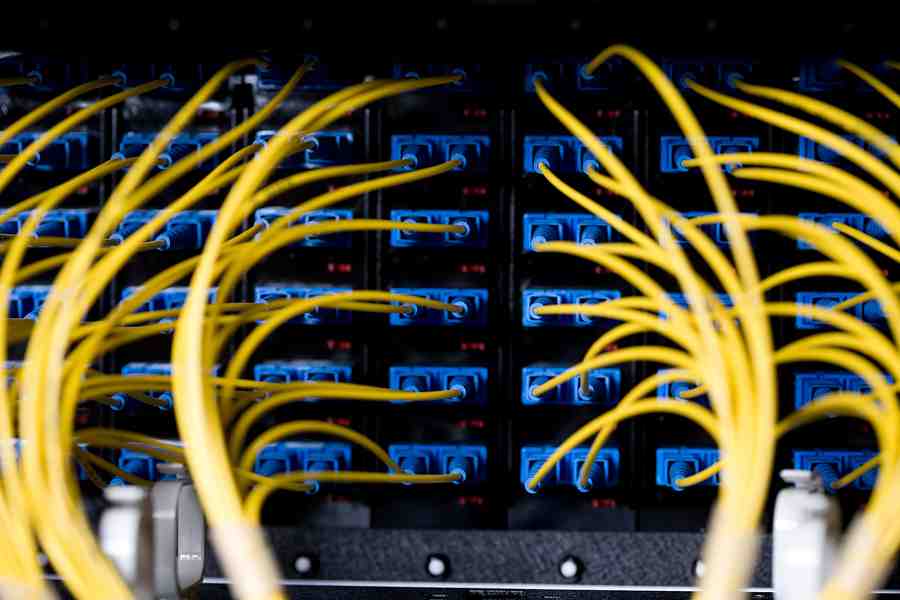
For businesses spanning multiple floors or large campuses in cities like Worcester or Nashua, copper has its limits. Fiber optic cabling offers virtually unlimited bandwidth and total immunity to electromagnetic interference. It is the gold standard for connecting server rooms to telecommunications closets (the “backbone”) or linking separate buildings.
The Professional Installation Process for Commercial Facilities
A professional Ethernet cable installation service follows a rigorous, step-by-step process to ensure nothing is left to chance.

- Site Survey: We walk the facility to identify obstacles, measure distances, and locate potential sources of interference.
- Pathway Design: We plan the most efficient routes using J-hooks to support cable weight and conduit where physical protection is needed.
- Cable Pulling: Cables are carefully pulled to avoid over-tensioning, which can damage the internal twists and degrade speed.
- Termination: This is the “art” of the job. Cables are terminated at the Ethernet Cable Installation wall jack and the patch panel with precision.
- Labeling: Following TIA-606 standards, every single drop is labeled at both ends. No more guessing which port goes to which desk.
- Certification Testing: We use expensive, specialized testers to certify that every run meets the required speed and performance metrics.
- As-Built Documentation: You receive a map and report of your new network for future maintenance.
Retrofitting Existing Office Buildings
Many of our clients operate in beautiful, historic New England buildings. Installing modern tech in a 100-year-old office in Providence or a converted mill in Lowell requires specialized skills. We use wall fishing techniques and surface-mount raceways when internal wall access isn’t possible, ensuring minimal disruption to your daily operations.
New Construction Advantages
If you are currently in the planning stages of a new build, now is the time to call us. Installing cabling during the “open wall” phase of construction can result in 30-40% labor savings. It allows for optimized pathways and perfectly integrated server rooms that aren’t possible once the drywall is up.
Estimating the Cost of Commercial Network Cabling
Note: All prices mentioned are average costs sourced from publicly available internet data and are not the actual prices of AccuTech Communications.
Budgeting for a network project requires understanding that labor typically accounts for 60-70% of the total cost. The complexity of your building—such as ceiling height and wall material—plays a huge role in the final quote.
Budgeting by Project Size
Based on industry averages, here is what businesses can typically expect for professional Ethernet cable installation services:
- Per-Drop Industry Average: $150 to $900 per drop (including labor, materials, and termination). The wide range accounts for simple runs versus difficult outdoor or high-ceiling warehouse installations.
- Small Office (5-15 drops): $2,500 – $15,000.
- Medium Business (15-50 drops): $7,500 – $45,000.
- Enterprise Facilities (50-200+ drops): $25,000 – $150,000+.
We always recommend including a “growth margin” of 20-30% extra ports. Adding a single drop later can cost 40-60% more per port than doing it during the initial project mobilization.
Factors Influencing Final Quotes
- Plenum Requirements: If your office uses the space above the ceiling for air return, you must use plenum-rated cable, which can add 50-70% to material costs.
- Building Material: Drilling through concrete or brick in an old Boston brownstone is more labor-intensive than standard drywall.
- State-Specific Permits: Permit fees in MA, NH, or RI typically range from $50 to $400 for commercial low-voltage work.
Frequently Asked Questions about Network Wiring
Can Ethernet be installed in existing commercial buildings?
Absolutely. While it is easier during new construction, professional installers have the tools to fish cables through existing walls. In cases where the walls are solid (like brick or concrete), we use neat, professional surface-mount raceways to protect the cables while maintaining the office’s aesthetic.
How long does a typical commercial installation take?
For a small office with 10-12 drops, we can usually finish in 1-2 days. Medium projects (15-50 drops) typically take 3-5 business days. Large-scale enterprise projects are usually phased over several weeks to coordinate with other trades.
Why is professional certification important for data cables?
A “link light” only tells you that electricity is moving. It doesn’t tell you if the cable is experiencing packet loss or crosstalk. Certification testing ensures the installation meets strict TIA/EIA performance standards, guaranteeing that your 10Gbps cable actually delivers 10Gbps.
Conclusion
Since 1993, AccuTech Communications has been the trusted partner for businesses across Massachusetts, New Hampshire, and Rhode Island. We don’t just pull wire; we build the infrastructure that allows your business to thrive in a digital-first world. From our headquarters in Massachusetts to our projects in the heart of Providence and Concord, our commitment to quality and certified excellence remains our top priority.
Don’t leave your business’s speed and security to chance. Whether you are moving into a new office or upgrading an existing facility, our team is ready to help you design a network that works as hard as you do.
