
Why the Right Commercial Network Cabling Contractor Makes or Breaks Your Infrastructure
Commercial network cabling contractors are the specialists businesses hire to design, install, test, and document the physical wiring infrastructure that carries voice, data, video, and security signals throughout a building.
Here’s a quick overview of what they do and why it matters:
| What They Do | Why It Matters |
|---|---|
| Design structured cabling systems | Ensures the network meets current and future capacity needs |
| Install copper (Cat6/Cat6A) and fiber cabling | Supports high-speed data, PoE devices, and wireless access points |
| Build out MDF/IDF telecom rooms | Creates a clean, organized, and scalable network backbone |
| Test and certify every cable run | Proves performance and may support eligibility for long-term manufacturer warranties |
| Provide as-built documentation | Speeds up future moves, adds, and changes |
| Integrate low-voltage systems | Connects security, AV, wireless, and building automation under one infrastructure |
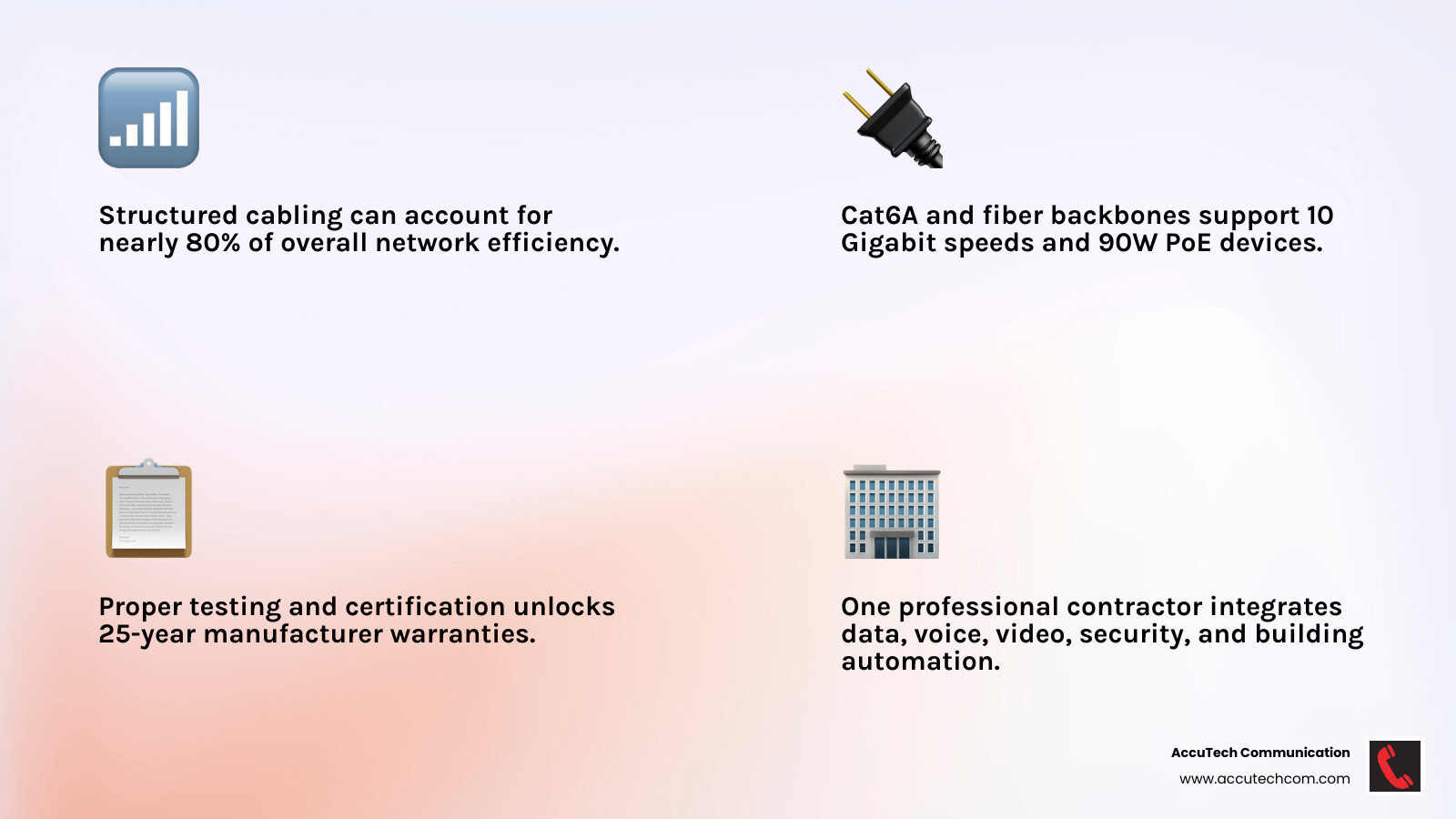
Most businesses do not think about their cabling until something breaks. But the structured cabling system, though often invisible inside walls and ceilings, is the foundation every other technology in your building depends on. According to industry research, cabling infrastructure can account for nearly 80% of overall network efficiency, even though it represents a small fraction of total network spending.
For businesses in Massachusetts, New Hampshire, and Rhode Island dealing with outdated wiring, a new commercial construction project, or a growing number of connected devices, working with a qualified cabling contractor is not optional if you want to stay operational and competitive.
I am Corin Dolan, owner of AccuTech Communications, and I have spent decades helping businesses across New England build reliable, scalable communication infrastructure. In this guide, I will walk you through what commercial network cabling contractors do, how to evaluate them, and what to look for when choosing the right partner for your project.
Commercial network cabling contractors word guide:
What Commercial Network Cabling Contractors Do
At a basic level, we design and install the wiring backbone that keeps commercial buildings connected. In practice, that means much more than pulling cable above a ceiling and hoping for the best.
A professional structured cabling contractor handles:
- Site surveys and pathway planning
- Horizontal copper cabling to work areas
- Fiber backbone cabling between telecom rooms
- MDF and IDF buildouts
- Patch panels, racks, cable management, and labeling
- Testing and certification
- As-built documentation and closeout packages
- Coordination with IT, facilities, electricians, and other trades
If you want a broader overview, see our page on commercial network cabling.
Why commercial network cabling contractors are essential for modern buildings
Modern buildings are packed with connected systems. It is no longer just desktops and phones. Today, your cabling may also support:
- Wi-Fi access points
- VoIP phones
- IP cameras
- Door access control
- Digital signage
- Conference room AV
- Building automation
- PoE lighting
- Sensors and IoT devices
That is why structured cabling is so critical. It creates a standardized architecture instead of a random bundle of one-off wires. Industry data shows more than 75% of new commercial construction now includes structured cabling during the design phase, and for good reason: planning early improves uptime, simplifies future moves, adds, and changes, and avoids ugly surprises after walls are closed.
In plain English: good cabling is boring in the best possible way. It quietly works for years.
What structured cabling includes in a commercial environment
A commercial structured cabling system usually includes several parts working together:
- Entrance facilities where outside services enter the building
- Backbone cabling that links the main room to other telecom rooms
- Horizontal cabling from telecom rooms to devices and outlets
- Telecommunications rooms, including MDF and IDF spaces
- Work area outlets and patching hardware
- Racks, cabinets, ladder tray, basket tray, and cable pathways
- Labels, test records, and documentation
The goal is consistency. Cabling should follow current TIA standards, be neatly supported, properly terminated, clearly labeled, and easy to troubleshoot later. If a technician opens a rack three years from now, they should not need detective skills and a flashlight clenched in their teeth.
Which facilities depend most on professional cabling
Almost every commercial facility depends on it, but demand is especially strong in:
- Offices with dense Wi-Fi, VoIP, conferencing, and hybrid work demands
- Healthcare facilities that require reliable connectivity and minimal disruption
- Education environments upgrading for digital learning
- Government buildings with security, documentation, and compliance needs
- Warehouses and distribution sites using scanners, wireless, cameras, and access control
- Data centers and server rooms where uptime is everything
Research shows nearly 38% of educational campuses are actively upgrading infrastructure for digital learning environments, and fiber continues growing faster than the overall cabling market. In 2026, that lines up with what we see across Massachusetts, New Hampshire, and Rhode Island: more bandwidth, more devices, and less tolerance for downtime.
How to Evaluate Commercial Network Cabling Contractors
Not all contractors deliver the same level of planning, workmanship, or documentation. When businesses compare proposals, the best choice is rarely the one with the fewest line items and the most vague promises.
For a deeper look at selection criteria, visit our page on network cabling services.
| Evaluation Area | What to Look For | Why It Matters |
|---|---|---|
| Certifications | BICSI credentials, manufacturer authorization, safety training | Confirms technical knowledge and standards alignment |
| Licensing | Required state low-voltage licensing where applicable | Helps verify legal compliance |
| Testing | Fluke DSX or equivalent certification testing | Proves the cabling actually performs to spec |
| Documentation | As-builts, labels, cable maps, patch panel schedules | Makes future support much easier |
| Warranty | Clear workmanship coverage and manufacturer-backed system warranty eligibility | Reduces long-term risk |
| Project process | Site survey, scope clarity, change control, closeout package | Prevents confusion and rework |
Certifications and licenses to require before awarding a project
When evaluating commercial network cabling contractors, we recommend checking for the following:
- BICSI certifications such as RCDD for design leadership and installer/technician credentials for field execution
- Manufacturer authorization for the cabling systems being installed
- State and local low-voltage licensing requirements where applicable
- Proof of insurance
- OSHA 10 or OSHA 30 safety training for field personnel
Why do these matter? Because a contractor can only deliver a manufacturer-backed system warranty if the project is installed according to that manufacturer’s requirements. And safety credentials matter too, especially in active offices, schools, healthcare spaces, and public buildings.
How quality is proven with testing, labeling, and warranties
A clean-looking install is nice. A certified install is better.
Professional contractors should test every copper run and fiber link using certification equipment such as Fluke DSX or equivalent tools. The results should show pass/fail performance against the specified category or fiber standard. Visual inspection alone is not enough.
Quality also includes:
- Labels on both ends of every cable
- Patch panel port schedules
- Cable IDs that match drawings
- As-built documentation reflecting actual installation conditions
- Punch list completion before closeout
- Warranty paperwork when the project qualifies
Many top structured cabling systems can support 25-year manufacturer warranties when installed by authorized contractors and documented correctly. That warranty is not magic dust. It depends on the contractor following the rules.
Questions to ask before signing a cabling proposal
Before you award a project, ask questions like these:
- Is the scope itemized by cable type, drop count, and location?
- Are patch panels, racks, cable management, and testing included?
- What cable category is being proposed, and why?
- Is there a pathway review for ceilings, conduits, and risers?
- Will the work be done during business hours, after-hours, or in phases?
- How are change orders handled?
- What testing standard will be used?
- What closeout documents will we receive?
- Will the installation qualify for a manufacturer system warranty?
- Who is the project manager and service contact after completion?
If the answers are fuzzy at the proposal stage, they usually do not get clearer mid-project.
Cabling Design Choices That Impact Performance and Cost
Technology choices drive both performance and project complexity. In 2026, the biggest design discussions usually involve Cat6 vs. Cat6A, fiber backbone strategy, PoE loads, and support for next-generation wireless.
For related planning guidance, see our page on commercial network cable installation pricing.

Cat6A, fiber backbone, and PoE++ planning in 2026
Cat6 still has a place in many commercial environments, but Cat6A is increasingly the safer long-term choice for higher bandwidth and high-power PoE applications. Industry research shows 55% of enterprises have moved from Cat5e to Cat6A in the last three years.
That shift is happening because Cat6A better supports:
- 10 Gigabit Ethernet over standard channel distances
- Higher-heat bundle conditions
- Modern wireless access points
- PoE++ devices using IEEE 802.3bt power levels up to 90W
The October 2024 ANSI/TIA-568.2-E update also strengthened the case for Cat6A in PoE-heavy environments. For Wi-Fi 6E and Wi-Fi 7 deployments, many designs now call for two Cat6A runs to each wireless access point location. That gives IT teams more flexibility for uplinks, redundancy, and future changes.
Fiber matters too. In many commercial buildings, the smartest design is fiber backbone plus copper horizontal cabling. Common choices include:
- OM4 multimode for high-speed in-building backbone links
- OS2 single-mode for longer runs, campus links, and future scalability
Fiber optic cabling is growing at an 8.6% CAGR through 2034, which is faster than the broader structured cabling market. That tells you where the industry is headed: more bandwidth, more density, more fiber.
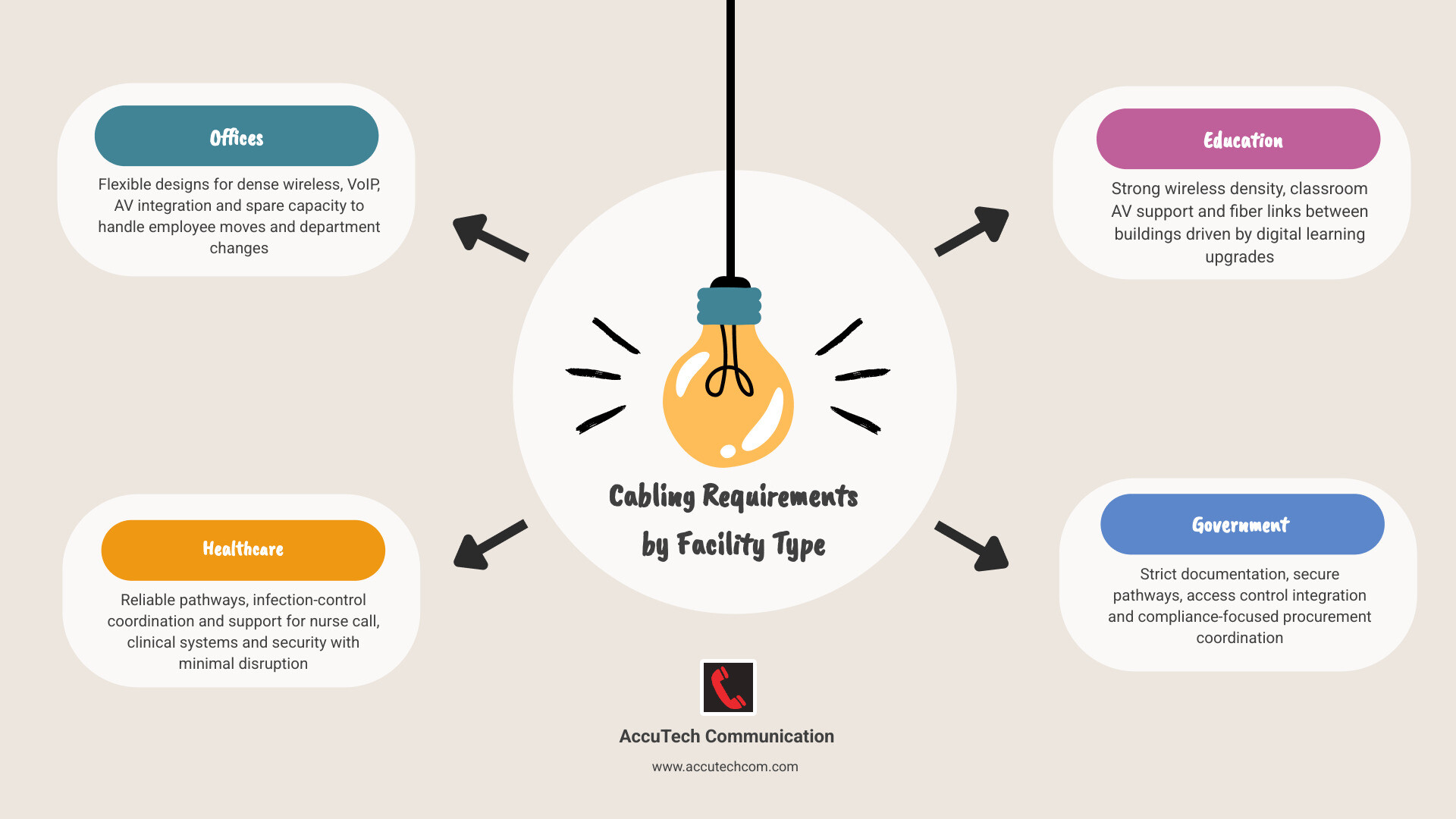
How requirements differ by office, healthcare, education, and government spaces
Different facilities have different priorities.
Offices
Office environments need flexibility. Employees move, departments shift, and conference rooms seem to multiply quickly. Cabling designs should account for:
- Dense wireless coverage
- VoIP phones and UC platforms
- AV integration
- Spare capacity for churn and growth
Healthcare
Healthcare spaces raise the stakes because downtime is not just annoying. It can affect operations and patient care. These sites often need:
- Reliable pathways and labeling
- Careful infection-control coordination
- Support for clinical systems, nurse call, and security
- Work staged to minimize disruption in occupied areas
Education
Schools and campuses often need strong wireless density, classroom AV support, and fiber between buildings. Research shows education remains a major upgrade segment, driven by digital learning and campus modernization.
Government
Government facilities typically require stricter documentation, secure pathways, access control integration, and close coordination around compliance and procurement requirements.
Average commercial cabling costs and what drives pricing
We are not listing AccuTech Communications pricing here. Any cost references you may see in industry discussions are average ranges based on publicly available online data and broad industry averages, not quotes, guarantees, or actual rates from AccuTech Communications.
Commercial structured cabling costs vary widely based on project type and site conditions. A realistic market range can span from a few thousand dollars for a small, straightforward office scope to three times that amount or far more for larger, higher-complexity, fiber-heavy, after-hours, or multi-room projects.
The biggest drivers usually include:
- Total number of drops
- Cat6 versus Cat6A
- Fiber type and strand count
- Distance and pathway difficulty
- Ceiling type and building construction
- Need for conduit, sleeves, coring, or firestopping
- Occupied versus unoccupied work areas
- Testing, labeling, and documentation requirements
- Telecom room buildout scope
- After-hours or phased scheduling
- Permit, compliance, or prevailing-condition requirements
That is why two buildings with the same square footage can produce very different cabling budgets.
Why the lowest bid often costs more later
The cheapest proposal can become the most expensive one if it leads to:
- Failed certification tests
- Poor labeling
- Missing documentation
- Messy telecom rooms
- Surprise change orders
- Warranty gaps
- Disruption to business operations
- Rework after ceiling closure or occupancy
A low bid often leaves out the boring but essential parts: pathway planning, complete testing, cleanup, cable management, and closeout documentation. Those are exactly the things that save time and money later.
Services Full-Service Contractors Often Provide Beyond Data Cabling
Many businesses prefer a contractor who can support multiple low-voltage systems under one project plan. That reduces coordination headaches and helps keep installations consistent.
Learn more about our broader commercial wiring services.
When a single contractor improves coordination and accountability
Using one qualified contractor for multiple systems can simplify:
- Scheduling across trades
- Device location coordination
- Shared cable pathways
- Rack and telecom room planning
- Testing and handoff
- Ongoing support after occupancy
It also gives you one point of contact instead of a small committee of people all explaining why something is someone else’s problem.
Common add-on systems installed with structured cabling
Full-service commercial cabling contractors often support:
- Wireless access point cabling
- IP security camera cabling
- Door access control
- Business phone systems and VoIP
- AV and conference room cabling
- Sound masking
- Digital signage
- Distributed antenna systems
- Nurse call systems
- PoE lighting
- Data center and server room buildouts
At AccuTech Communications, we focus on commercial clients across Massachusetts, New Hampshire, and Rhode Island with solutions that may include network cabling, business phone systems, and data center technologies.
Planning for growth, renovations, and technology refresh cycles
Good cabling design should not only support what you need today. It should leave room for tomorrow.
That may include:
- Spare pathway capacity
- Additional rack space
- Reserved patch panel ports
- Extra backbone fiber strands
- Expansion-ready IDF layouts
- Staged renovation plans for occupied buildings
Smart building systems, IoT devices, Wi-Fi 7, and higher-density fiber are all increasing infrastructure demands in 2026. If a building is being renovated now, it makes sense to design for that future instead of re-opening ceilings again two years later.
Choosing the Right Partner for Multi-Site Rollouts in MA, NH, and RI
Multi-location projects are their own sport. You are not just installing cable. You are managing consistency across multiple addresses, schedules, and stakeholders.
For related support, see our pages on network installers and network cable installation.
What businesses should look for in multi-location execution
For multi-site rollouts across Massachusetts, New Hampshire, and Rhode Island, look for a partner that can provide:
- A single project manager
- Standardized labeling and documentation rules
- Site surveys before deployment
- Clear deployment schedules
- Consistent materials and testing methods
- Procurement coordination
- Post-installation support across all locations
Consistency matters. If Site A is labeled one way and Site B another way, your IT team inherits a preventable headache.
Regional demand trends shaping commercial network cabling contractors
In our region, the strongest demand in 2026 is coming from:
- New commercial construction with structured cabling designed in from day one
- Office retrofits replacing older Cat5e-era wiring
- School and campus upgrades for digital learning and dense wireless
- Healthcare expansion and modernization
- Warehouse and logistics growth requiring fiber, wireless, and security integration
- Public sector and government projects with strong documentation needs
These trends are especially relevant in Eastern Massachusetts, the Boston metro, southern New Hampshire, and Rhode Island, where existing building stock and technology modernization often go hand in hand.
Helpful examples of structured cabling services in New England
If you are researching regional service examples, these references may be useful:
- The No-Nonsense Guide to Commercial Cabling Companies
- Commercial Cable Company
- Network Cabling Company
- Network Cabling Near Me
- Cable Contractors Near Me
Frequently Asked Questions about Commercial Network Cabling Contractors
What is the difference between a cabling brand and a cabling contractor?
This is a common point of confusion.
A cabling brand is the manufacturer of the products: cable, jacks, patch panels, fiber hardware, and connectivity components. A cabling contractor is the company that designs, installs, terminates, tests, labels, and documents the system in the field.
Both matter. Great products installed poorly still fail. And even the best contractor cannot create a warrantied system using the wrong parts or methods. That is why manufacturer authorization and field certification both matter.
How long does a commercial network cabling project usually take?
It depends on the size and complexity of the project. A small office addition may move quickly, while a multi-floor occupied renovation or multi-site rollout takes longer.
Typical schedule drivers include:
- Site survey and design review
- Material lead times
- Building access and work windows
- Ceiling and pathway conditions
- Number of drops and telecom rooms
- Fiber splicing or backbone work
- Testing, punch list, and closeout
Occupied offices, healthcare spaces, and schools often require phased installs or after-hours cutovers to reduce disruption.
What should be included in the final closeout package?
A proper closeout package should usually include:
- Copper and fiber test reports
- As-built drawings
- Cable labels and cable ID schedules
- Patch panel and port mapping
- Rack elevations where applicable
- Warranty paperwork
- Punch list completion records
If you do not receive documentation at the end, the project is not really finished. It is just hidden.
Conclusion
The best commercial network cabling contractors do far more than pull cable. They help businesses create reliable, standards-based infrastructure that supports voice, data, video, wireless, security, and future growth.
At AccuTech Communications, we have been serving commercial clients since 1993 with a focus on certified service, dependable workmanship, and competitive pricing across Massachusetts, New Hampshire, and Rhode Island. Whether you are planning a new office, upgrading aging infrastructure, or coordinating a multi-site rollout, we believe the right cabling partner should make your technology easier to manage, not harder.
If you want to learn more, explore our resources on network cabling services and network cabling company.
